
What Is MIDA? The Unelected Agency Behind the Box Elder Data Center
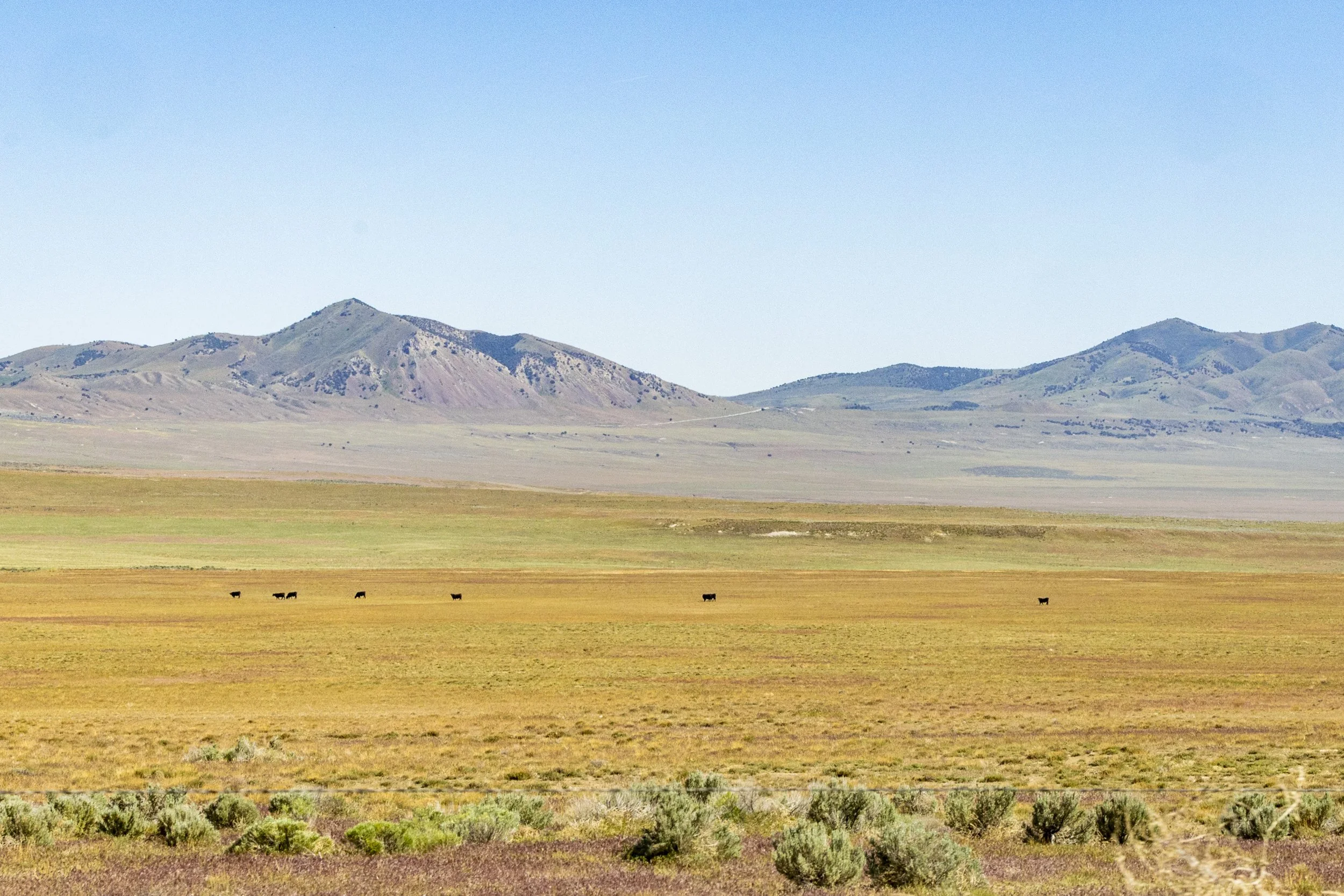
Hansel Valley in western Box Elder County, the remote site where MIDA approved the 40,000-acre Stratos data center. Cattle still graze land that an unelected state board can now develop without local zoning control. Photo by Isaac Hale, Deseret News, used by permission.
The proposed data center in Box Elder County has dominated the news, and I have heard from many of you about it. My position is straightforward. The Military Installation Development Authority (MIDA), the state agency at the center of this project, needs to be audited, reformed, and seriously evaluated for whether it should continue to exist in its current form. I am not for or against the data center itself. What concerns me is how a project of this size moved forward, and what it reveals about an agency that has grown far beyond its original purpose.
Here is what MIDA is, how it has changed, and why I believe it now demands a hard look.
What I Believe Needs to Happen
I will start with the conclusion.
An independent audit. The Legislature should commission a full, independent audit of MIDA's operations, finances, governance structure, and the long-term effect of its tax increment financing on school districts and local governments. As it stands, MIDA is audited by a private firm it selects and pays itself, and the Utah State Auditor does not audit the agency or control that contract. Utah taxpayers should know exactly what MIDA costs and what it delivers, and that knowledge should come from a truly independent review.
A hard look at the governance structure. MIDA is run by an appointed board, not by officials directly accountable to voters. That structure warrants a serious, good-faith examination, including the question of whether sitting legislators should serve on the board of an authority the Legislature controls.
A return to mission. MIDA was created for a specific reason. Its scope today bears little resemblance to that reason. The Legislature should define clearly what MIDA is actually for and decide whether its current reach can be justified.
Real accountability standards. Any MIDA project that involves significant tax preferences should carry enforceable performance benchmarks and clawback provisions, so that public benefits come with public accountability.
And if meaningful reform proves impossible, elimination should be on the table. I am not calling for MIDA's elimination today. But an agency operating at this scale, with this degree of independence from voters and this much drift from its founding purpose, cannot continue indefinitely without real structural change.
Here is how we got here.
What MIDA Was Built to Do
In the 1990s, the federal government's Base Realignment and Closure process, known as BRAC, put military installations across the country at risk of closure. Hill Air Force Base is the economic backbone of northern Utah. Losing it would have been a serious blow to our economy and to national defense.
The Utah Legislature responded. In 2007, it created the Military Installation Development Authority, MIDA, to help make Hill more economically self-sustaining. The idea was to let a dedicated authority develop underutilized land around military installations, generate private revenue, and use that money to support the base and reduce its reliance on federal appropriations. The model came from a federal program called the Enhanced Use Lease, which lets military installations lease property to private developers to generate income.
MIDA's first project, Falcon Hill Aerospace Research Park at Hill, fit this purpose. Private development on underutilized Air Force land, with revenue flowing back to the base. The research park has since grown into the largest enhanced use lease in the Air Force.
How MIDA Changed
What began as a focused, mission-specific tool did not stay that way.
Over time, the Legislature expanded MIDA's authority well beyond its original rationale. Today the agency can create project areas, issue bonds, finance infrastructure, negotiate development agreements, levy certain taxes, and redirect future tax revenue through tax increment financing. Its portfolio now includes major developments with no real connection to a military base.
The clearest example is the Military Recreation Facility project area in Wasatch County. It started in 2012 as a roughly 40-acre footprint and has grown to oversee billions of dollars of development around the Jordanelle Reservoir, including Deer Valley's East Village expansion and the neighboring SkyRidge golf and equestrian community. The justification is a thin one. Decades ago, the Air Force operated a small recreation lodge, so the developments now include a hotel, the Grand Hyatt Deer Valley, with rooms set aside at discounted rates for service members.
By the time East Village and SkyRidge are complete, they are projected to add nearly 1,300 single-family homes, more than 3,200 condos and townhomes, and over 1,300 hotel rooms in the Jordanelle Basin. MIDA budgeted roughly $274 million for East Village infrastructure. It has issued a $390 million bond to speed up construction, on top of $260 million in bonds authorized in 2021. MIDA's total revenue reached $68.1 million in fiscal year 2024, an increase of more than $7 million over the prior year, driven largely by these Wasatch County developments.
An agency built to protect Hill Air Force Base is now one of the largest development players in the state, operating in places that have little to do with the military.
How the Money Works, and Who Pays
MIDA is funded largely through tax increment financing. This is a legitimate and widely used tool, but most Utahns have never heard of it and do not understand how it affects them.
Here is the short version. When MIDA creates a project area, it captures the increase in property tax revenue generated by new development inside that area. Under the Deer Valley arrangement, MIDA keeps 75 percent of that new property tax revenue, for as long as 40 years, and redirects it to fund the project's infrastructure. Local schools and county services split the remaining 25 percent.
The public helps pay for these developments through tax revenue that would otherwise flow to schools and local governments. Supporters argue the developments eventually grow the tax base enough to benefit everyone, and that may prove true in some cases. But it is a real cost, paid over decades, and it happens whether or not the public is paying attention.
The Governance Question
Here is what gives me pause. MIDA is governed by an appointed board, not by officials directly accountable to voters. Five members are appointed by the governor, and the Senate president and speaker of the House each appoint one.
Two members of that board are sitting members of the Utah Legislature, and both have served on the board since 2008. These are serious public servants who have given real time to this work. But the structure itself raises a legitimate question that has nothing to do with the character of the individuals involved.
When members of the Legislature that controls and expands MIDA's authority also sit on the board that exercises that authority, the lines of accountability blur. Who provides independent oversight of MIDA when some of the people writing its statute are also helping run it? Good government depends on a clear separation between the body that grants authority and the body that wields it. That question deserves examination on its own terms, regardless of who holds the seats.
The Box Elder County Data Center
In the spring of 2026, MIDA became the vehicle for the Stratos project, a proposed hyperscale AI data center that began at 40,000 acres in western Box Elder County, backed by Kevin O'Leary and O'Leary Digital.
The approval mechanics tell the story. The MIDA board approved creating the Stratos Project Area in late April. Days later, after a meeting attended by hundreds of opposed residents, the three-member Box Elder County Commission voted unanimously to consent to the project area and enter an interlocal agreement with MIDA. That consent was the decisive act. Under the MIDA Act, once a county consents to include land in a project area, that consent is irrevocable. The commission's vote handed authority over the project to MIDA, and there is no taking it back.
Three county commissioners, in a single vote, turned over a 40,000-acre development to an appointed state board that local residents did not elect and cannot remove.
Whether data centers are good investments is a separate debate. Many Utahns who support technological growth and domestic energy still have real questions about this one, and those questions are not about artificial intelligence. They are about process. When the studies that should inform a decision of this magnitude, water use, power demand, infrastructure load, tax impact, are not finished and made public before the vote, the public is left to guess. People speculate because they were given nothing solid to work with. A project built on a foundation of public confidence can withstand scrutiny. A project rushed past it invites exactly the distrust we are now seeing.
There is also a stewardship question I keep returning to. Utah already offers one of the most business-friendly environments in the country, with low taxes, a skilled workforce, abundant energy, and a stable regulatory climate. If all of that is true, why are additional public incentives necessary at all? That is not an argument against development. It is a question of stewardship over public resources. The burden should rest on government officials and developers to demonstrate why those incentives are needed and what measurable benefit Utah families will see in return.
Where This Goes
The system is showing some signs of working.
Governor Cox has issued an executive order establishing a higher standard of review for large data center projects, directing state agencies to protect water, air quality, ratepayers, and the Great Salt Lake. The Legislature has voted to study the environmental impacts of data centers. Senate President Adams publicly called on the developer to cut the project's footprint significantly, and the developer has since agreed to reduce it by roughly half.
Whether you support this project or not, that is representative government responding the way it should. Listening to the public, taking concerns seriously, and demanding better information before major decisions are locked in.
I want that same responsiveness applied to MIDA itself. The data center brought this agency into public view, but the deeper issue is the agency. An authority that can reshape whole communities, governed by appointees rather than voters, spending public money with limited accountability, deserves a careful and honest review. That review starts with a simple question. Is MIDA still doing what we created it to do? If the answer is no, we owe it to the people of Utah to fix it.
A note on sources. The figures in this post come from primary and official records, not secondary summaries. MIDA's revenue and financial data are drawn from the agency's Annual Comprehensive Financial Reports, now consolidated on the Utah State Auditor's Transparent Utah MIDA dashboard (transparent.utah.gov/mida). The $390 million and $260 million bond figures come from MIDA's own board resolutions. The board's composition is set by Utah Code 63H-1-302. The irrevocability of a county's consent reflects the determination of the Box Elder County Attorney under the MIDA Act, and the East Village infrastructure and unit figures come from MIDA's project filings and meeting materials.
Rep. A. Cory Maloy represents House District 52, covering portions of Lehi, American Fork, and Saratoga Springs along the Silicon Slopes corridor. He chairs the House Business, Labor, and Commerce Committee and serves on the House Government Operations Committee.